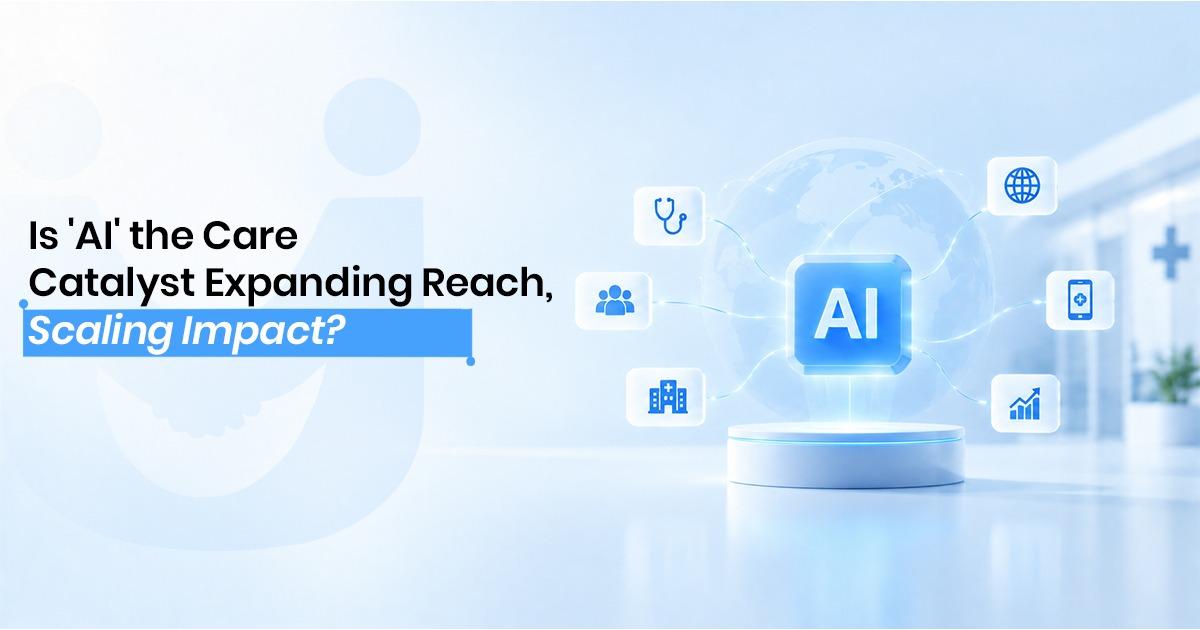
Artificial intelligence has moved from being a futuristic concept to becoming part of conversations about how healthcare can evolve. It has been proven that any industry which is keeping up the pace with the evolving technology has only become stronger and bigger. But selecting the right technology that suits your business is crucial and needs to be taken care of very wisely. One technology which has worked for many businesses is AI.
From analysing medical information to supporting administrative workflows, AI is increasingly being explored across different parts of the healthcare ecosystem.
But the more important question is not whether healthcare should use AI and, if yes, then where? AI can create meaningful value—and whether that value can ultimately improve access, efficiency, and the experience of care.
In a country as diverse and geographically expansive as India, this question becomes particularly relevant.
From Technology to Access
One of the biggest opportunities for AI in healthcare lies in extending capabilities beyond traditional boundaries.
Healthcare delivery can be constrained by geography, infrastructure, workforce availability, and the sheer volume of patients requiring services. AI-powered tools can potentially help healthcare organisations process information faster, support clinical and administrative teams, and make certain services more accessible.
For example, AI can assist with analysing large datasets, identifying patterns, supporting documentation, and helping prioritise information.
The technology does not necessarily have to replace a human decision-maker to create value.
Sometimes, making a healthcare professional more efficient can itself expand the reach of care.
Scaling Without Simply Adding Resources
Healthcare demand continues to grow, but resources cannot always grow at the same pace.
Adding more facilities, professionals, and infrastructure is important, but scalability also requires organisations to improve how existing resources are used.
This is where AI can become a potential care catalyst.
Routine administrative tasks can consume significant amounts of time. Information may need to be reviewed, categorised, documented, or transferred between systems.
When appropriate AI capabilities are integrated into these workflows, professionals may be able to spend less time on repetitive tasks and more time on activities that require human judgement and interaction.
The impact can extend beyond individual efficiency. At scale, even small improvements across thousands of interactions can translate into meaningful operational gains.
AI Needs the Right Foundation
However, beyond all this AI cannot solve disconnected healthcare systems on its own.
An organisation need to have sophisticated AI tools to fix this. But if its underlying information is fragmented, incomplete, or difficult to access, the value of those tools can be limited.
This makes digital infrastructure an important part of the AI conversation.
Connected systems can create a more structured environment in which relevant information is available across appropriate workflows. Better data foundations can help organisations use analytics and AI more effectively.
In other words, the AI conversation should not begin with the algorithm. It should begin with the data, processes, systems, and people around it.
Human Expertise Still Matters
Healthcare is deeply human. It involves a lot of close care and observation. A good patient care experience comes with the right technology, but at the same time it involves human expertise.
Empathy, clinical judgement, communication, experience, ethics, and trust cannot simply be reduced to data points.
AI can analyse information quickly, identify patterns, and support decisions. But healthcare professionals remain responsible for understanding context and applying judgement.
The most meaningful model may therefore not be AI versus humans, but AI with humans.
Technology handles what technology does well. People handle what requires experience, empathy, accountability, and human connection.
Can AI Truly Expand Healthcare Reach?
The answer depends on how it is implemented.
AI has the potential to support remote services, improve operational efficiency, assist healthcare professionals, analyse large volumes of information, and enable organisations to serve more people with existing resources.
But scaling technology without considering accessibility, data quality, privacy, security, governance, and user experience can create new challenges.
The objective should therefore not be to add AI everywhere. It should be to identify where AI can solve a real problem.
Building the Connected Healthcare Ecosystem
At IUI Solutions, we believe technology creates the greatest impact when it works as part of a connected ecosystem.
Our flagship product, HealthDoc HMS, focuses on connecting hospital processes. From registration and consultations to diagnostics, admissions, discharge, records, billing and other operational workflows, it helps in streamlining and structure these processes so that they can be accessed by the right person at the right time.
As healthcare organisations become more digitally connected, technologies such as analytics, automation, and AI can potentially build on this foundation to create greater operational intelligence and efficiency.
The future may not be about an AI-powered healthcare system replacing the human system. It may be about creating a better-connected healthcare ecosystem where technology helps people reach more patients, make better-informed decisions, and deliver care more efficiently.
AI may be the catalyst.
But people, processes, data, and purpose will determine the impact.